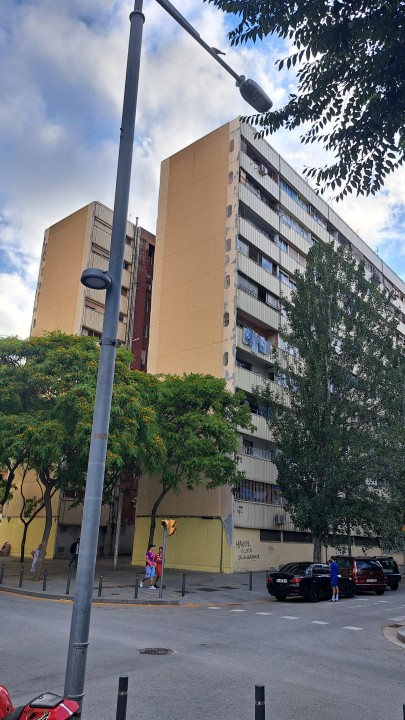
Right from the beginning of ISHF – International Social Housing Festival 2023 site visit to ‘La Mina’ we feel that there is tension in the neighbourhood. Our guide is a project coordinator of a big urban renewal project in the area. He had rather received us in the morning, as he explains, there would be less people in the streets and it would be safer for us to walk in between the big concrete apartment buildings. Now, the tour is in the evening, we are at the main road perpendicular to the buildings and we don’t stop taking pictures.
We pass by gigantic 11-floor flats and fully paved urban spaces in between. Boys are hanging around, we hear fireworks in the back, homeless men search for food in garbage bins, there is a sound of Christian worship, coming from a garage box. Expensive cars with loud music are passing by and a man holding a bird cage watching us as we walk by.
Epic history
Only at the other end of the area, the guide takes a breath and continues the story, which is rather epic. La Mina was built in the 60s and 70s’ as a final project of a slum clearance programme. Until the 60s’, there were many slums in Barcelona and of the most visible ones was the Somorrostro slum, right at the shore (currently the Olympic village and Olympic harbour). It was in the 60s’ that dictator Franco ordered to clean the slum and relocate the families. The estates in la Mina were built to relocate the last (and regarded as most difficult) slum dwellers.
La Mina, back then was located in the outskirts of the city, beyond the border of the municipality. The biggest buildings are 11-storey high concrete slabs, containing big apartments (62 m2 usable space, 85 m2 total). They were publicly funded. After paying a deposit, and after paying rent for 24 years, the dwellers became owners. Right now the apartments are owned by a wide variety of home-owners (both residents and landlords), which makes any regeneration project very difficult.
Right from the start, all ingredients to stir social problems were present: new inhabitants of La Mina had no experience of living in apartment flats, moreover they were unfamiliar with the area and the public institutions. And finally, there was little help because the municipality that they moved to, Sant Adria de Besos was very small and poor. Up until today, La Mina is the poorest area of the city. It is known for drug dealing, violence and extreme poverty, and illiteracy unemployment rates are among the highest.
Urban regeneration plan
The municipalities of Sant Andria de Besos and Barcelona, the metropolitan government and the region of Catalonia teamed up in a consortium to improve the neighbourhood. A plan was designed to open up the area to the city by adding a tram line, to partly demolish the massive apartment blocks, to create a new ‘rambla’ with a sea view, and finally to build new projects along this main road, both to relocate residents and to add market rental apartments.
The biggest challenge of the project was relocating the tenants and homeowners of the old buildings. The consortium worked on the right financial conditions to move. The owners (whether they were resident or landlord) would receive the appraised value for their apartments in the old building. If needed the consortium would provide additional loans. This would enable them to buy a similar apartment in a new building along the new main road at zero costs, only having to cover expenses in case they wanted to move to a larger flat. Social tenants were enabled to move from the old to the new without rent increase.
Disaster
In 2012, just after the consortium had realised its first apartments for relocation of tenants, the project got hit by the global financial crisis in a terrific way. The landlords could not obtain funding to invest in affordable rental projects and without landlords it was impossible for tenants to move from the old buildings to the new ones. So, the apartments remained vacant and finally were squatted.
Up until today, the apartments are occupied, leaving the consortium with a financial construction that has proven to be very vulnerable to financial crises, with new apartment buildings that bear traces of being squatted for 10 years and last but not least, with very disappointed local residents who were promised better living circumstances but who have to remain in the old buildings.
While walking along the rambla, the guide points us the traces of squatting. External doors to technical spaces were damaged in order to illegally connect to water, electricity and even gas supply. We see poorly maintained facades, garbage at the balconies. ‘We need to be very careful with these people, as they are families and should not be evicted without an alternative home. It appears that we need to relocate even more people now,’ he says.
Future
Despite all problems, the consortium keeps on working. Social workers try to help the dwellers as much as they can. Vacant plots along the rambla are waiting for new development giving hope that the area could change for the better. The presence of a newly installed police station and of the company acting as reference point for residents concerned with the urban renewal plan also contribute to smoother running of the project. Last but not least, the positive change brought about by the new rambla axis is both practical and symbolic: what was before a ‘dead end’ place cut out from the city has been opened up and connected – breaking the sense of isolation and claustrophobia which must have been adding to the (undeniably huge) social problems in the past.
(this article is part of a series of blog articles for the ISHF live blog website, in collaboration with Housing Europe)
 Pepijns Post