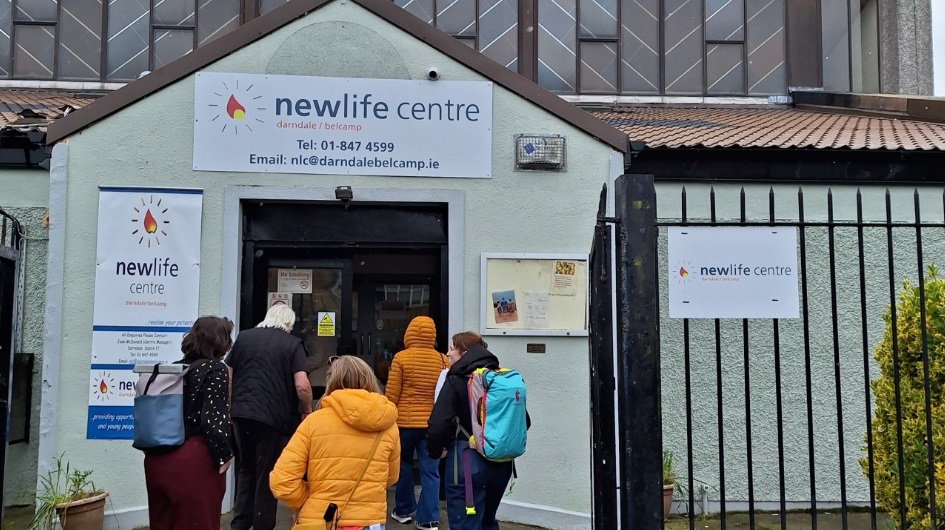
In the middle of a run-down, rough neighborhood northeast of Dublin’s city center lies the Darndale Belcamp village center—an oasis of love and care in an area marked by nuisance and riots. Locals gather here to share meals, participate in art programs, attend language classes, and work in the community garden.

Darndale, a neighborhood about 40 minutes by bus from the city center, is the product of innovative 1970s urban planning. It consists of 900 row houses, all built as social housing for families. At the time, it was considered highly progressive: the entire neighborhood was designed to be car-free. A church and a community center were built at the heart of the neighborhood, and children could play safely between the houses. On paper, it must have looked ideal.
Unfortunately, the plan didn’t unfold as expected. The large number of identical homes for a single demographic—low-income families—combined with the area’s relative isolation and pedestrian-only layout, made the neighborhood difficult to navigate and control. Public spaces were soon taken over by gangs, while residents withdrew behind their front doors and high garden fences.
Starting in the 1980s, Darndale underwent a regeneration project. House entrances were adjusted, fences were removed, and streets for cars were added. Eventually, the area came to resemble any other Dublin suburb. The experiment was over.

Richie and Susan, long-time residents since the neighborhood’s inception, give us a tour. They point out that many problems persist. Public spaces are poorly maintained, and most interventions seem aimed at control rather than improvement. Poles and concrete blocks line the roads to prevent cars from driving on pedestrian paths. Susan explains that the streets are often used for joyriding and illegal car racing, which causes both nuisance and danger. Some streets are blocked off with high fences—meant to stop rioters from escaping police. We pass remnants of burned-out fire pits in the meadows.
Yet Richie and Susan don’t seem to feel unsafe. “Live and let live,” they say. They prefer to talk about the positive things happening at the Belcamp village center and the beautiful walled garden next to it. Richie, for example, proudly volunteered as the MC for the community center’s theater. He tells us they’ve hosted numerous Irish cabaret groups, enjoyed plenty of Guinness, and had a lot of fun. His eyes sparkle.
(ISHF site visit : Triangle Atop Square, Wednesday 4 June, 14:00 hrs.)

