“I am an expert in something I never wanted to be an expert in,” says Loïc Sauvage, primarily a lecturer in the European Studies unit at the Université de Liège. But because he uses a wheelchair, he has also become an expert and advocate for improving accessibility at his university. Every day, he experiences the discomfort of a campus that is not adapted to the needs of disabled people.
At the UNIC staff week Redesigning the Campus in the City, Sauvage introduces a group of European campus‑planning experts to the topic of accessibility.
He begins by presenting figures that illustrate the “disability gap” in higher education. Across the EU, only 30% of disabled people aged 24 to 35 have completed higher education, compared to 45.9% of non‑disabled people. Disabled students are also far more likely to leave education without a diploma: 44% compared to 8% among non‑disabled students. As Sauvage stresses, disability should never determine whether someone can participate in higher education. Education must be for everyone.
Although the issue is not new, universities have taken measures in the past, yet not always the right ones. Their efforts have typically focused on infrastructure alone. But, as Sauvage explains, accessibility has multiple dimensions: it is also about digital accessibility and about how buildings are operated and used.
For example, a wheelchair lift may be installed to bridge a height difference that non‑disabled people take by stairs. But such lifts are often placed in a corner and frequently used as temporary storage space for deliveries and garbage. In those moments, the lift becomes unusable and the building becomes inaccessible.
More broadly, we need to move away from the paradigm in which buildings are designed primarily for non‑disabled users, with temporary adjustments added later for disabled people. Sauvage calls this the “DIY paradigm of inclusion”: universities “help” disabled people by expecting them to adapt to the norm through ad‑hoc fixes, placing them in a permanent position of having to ask for accommodations.
Instead, universities should adopt an accommodative design approach. Educational spaces and offices should be designed for everyone from the outset. No one should have to ask for help simply to participate.
The challenge for campus planners is that, unlike Sauvage, they are not experts in physical accessibility. For non‑disabled people, it is extremely difficult to imagine what disabled users need. Despite good intentions, this lack of lived experience often results in imperfect designs.
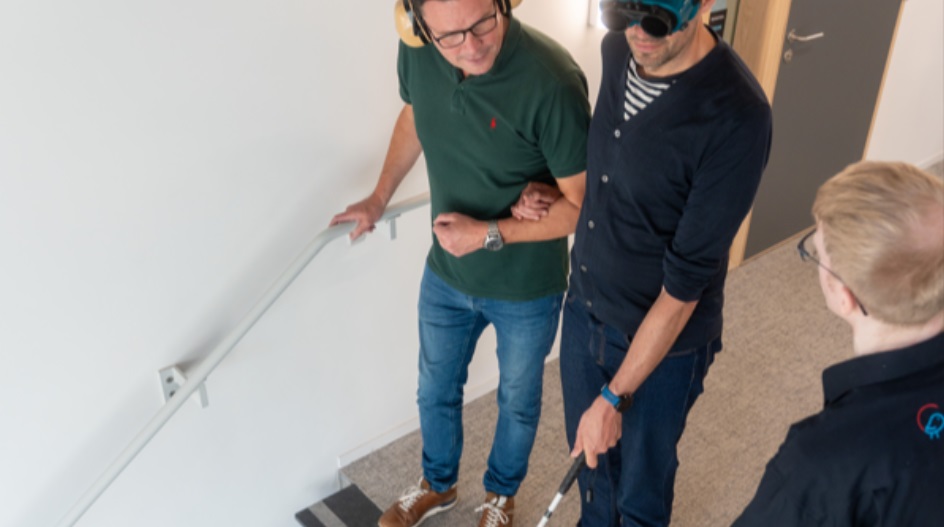
Right after Sauvages introduction, we participated in a workshop by Passe Muraille, who brought wheelchairs and goggles that simulate visual impairments. We visited a toilet in a wheelchair and discovered how difficult it was to wash our hands: the tap was hard to reach, and the soap dispenser was mounted too high. We put on the goggles and noticed that floor‑to‑ceiling glass panels were hard to distinguish from the door next to them. On the staircase, it became difficult to see where one step ended and the next began.
We concluded that experts with lived experience must be included from the very beginning of the design process. Our goal should be to create environments that accommodate everyone, rather than expecting disabled people to adjust to a norm. This is not only a practical necessity -it is a moral obligation. The core value of a university is that knowledge and education must be accessible to all.

